
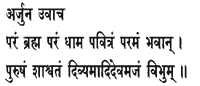
Arjuna said: Thou art the supreme Brahman, the supreme Abode, the supreme Purity, the one permanent, the divine Purusha, the original Godhead, the Unborn, the all-pervading Lord.
Deva and Asura
Sri Aurobindo
THE PRACTICAL difficulty of the change from the ignorant and shackled normal nature of man to the dynamic freedom of a divine and spiritual being will be apparent if we ask ourselves, more narrowly, how the transition can be effected from the fettered embarrassed functioning of the three qualities to the infinite action of the liberated man who is no longer subject to the gunas. The transition is indispensable; for it is clearly laid down that he must be above or else without the three gunas, trigun. ¯ at¯ıta, nistraigun. ya. On the other hand it is no less clearly, no less emphatically laid down that in every natural existence here on earth the three gunas are there in their inextricable working and it is even said that all action of man or creature or force is merely the action of these three modes upon each other, a functioning in which one or other predominates and the rest modify its operation and results, gun. ¯a gun. es.u vartante. How then can there be another dynamic and kinetic nature or any other kind of works? To act is to be subject to the three qualities of Nature; to be beyond these conditions of her working is to be silent in the Spirit. The Ishwara, the Supreme who is master of all her works and functions and guides and determines them by his divine will, is indeed above this mechanism of quality, not touched or limited by her modes, but still it would seem that he acts always through them, always shapes by the power of the swabhava and through the psychological machinery of the gunas. These three are fundamental properties of Prakriti, necessary operations of the executive Nature-force which takes shape here in us, and the Jiva himself is only a portion of the Divine in this Prakriti. If then the liberated man still does works, still moves in the kinetic movement, it must be
so that he moves and acts, in Nature and by the limitation of her qualities, subject to their reactions, not, in so far as the natural part of him persists, in the freedom of the Divine. But the Gita has said exactly the opposite, that the liberated Yogin is delivered from the guna reactions and whatever he does, however he lives, moves and acts in God, in the power of his freedom and immortality, in the law of the supreme eternal Infinite, sarvath¯a vartam¯ano’pi sa yog¯ı mayi vartate. There seems here to be a contradiction, an impasse. But this is only whenwe knot ourselves up in the rigid logical oppositions of the analytic mind, not when we look freely and subtly at the nature of spirit and at the spirit in Nature. What moves the world is not really the modes of Prakriti,—these are only the lower aspect, the mechanism of our normal nature. The real motive power is a divine spiritualWill which uses at present these inferior conditions, but is itself not limited, not dominated, not mechanised, as is the human will, by the gunas. No doubt, since these modes are so universal in their action, they must proceed from something inherent in the power of the Spirit; there must be powers in the divine Will-force from which these aspects of Prakriti have their origin. For everything in the lower normal nature is derived from the higher spiritual power of being of the Purushottama, mattah. pravartate; it does not come into being de novo and without a spiritual cause. Something in the essential power of the spirit there must be from which the sattwic light and satisfaction, the rajasic kinesis, the tamasic inertia of our nature are derivations and of which they are the imperfect or degraded forms. But once we get back to these sources in their purity above this imperfection and degradation of them in which we live, we shall find that these motions put on a quite different aspect as soon as we begin to live in the spirit. Being and action and the modes of being and action become altogether different things, far above their present limited appearance. For what is behind this troubled kinesis of the cosmos with all its clash and struggle? What is it that when it touches the mind, when it puts on mental values, creates the reactions of desire, striving, straining, error of will, sorrow, sin, pain? It is a will of the spirit in movement, it is a large divine will in action which is not touched by these things; it is a power2 of the free and infinite conscious Godhead which has no desire because it exercises a universal possession and a spontaneous Ananda of its movements. Wearied by no striving and straining, it enjoys a free mastery of its means and its objects; misled by no error of the will, it holds a knowledge of self and things which is the source of its mastery and its Ananda; overcome by no sorrow, sin or pain, it has the joy and purity of its being and the joy and purity of its power. The soul that lives in God acts by this spiritual will and not by the normal will of the unliberated mind: its kinesis takes place by this spiritual force and not by the rajasic mode of Nature, precisely because it no longer lives in the lower movement to which that deformation belongs, but has got back in the divine nature to the pure and perfect sense of the kinesis. And again what is behind the inertia of Nature, behind this Tamas which, when complete, makes her action like the blind driving of a machine, a mechanical impetus unobservant of anything except the groove in which it is set to spin and not conscious even of the law of that motion,—this Tamas that turns cessation of the accustomed action into death and disintegration and becomes in the mind a power for inaction and ignorance? This tamas is an obscurity which mistranslates, we may say, into inaction of power and inaction of knowledge the Spirit’s eternal principle of calm and repose—the repose which the Divine never loses even while he acts, the eternal repose which supports his integral action of knowledge and the force of his creative will both there in its own infinities and here in an apparent limitation of its working and selfawareness. The peace of the Godhead is not a disintegration of energy or a vacant inertia; it would keep all that Infinity has known and done gathered up and concentratedly conscious in an omnipotent silence even if the Power everywhere ceased for a time actively to know and create. The Eternal does not need to sleep or rest; he does not get tired and flag; he has no need
of a pause to refresh and recreate his exhausted energies; for his energy is inexhaustibly the same, indefatigable and infinite. The Godhead is calm and at rest in the midst of his action; and on the other hand his very cessation of action would retain in it the full power and all the potentialities of his kinesis. The liberated soul enters into this calm and participates in the eternal repose of the spirit. This is known to everyone who has had any taste at all of the joy of liberation, that it contains an eternal power of calm. And that profound tranquillity can remain in the very heart of action, can persevere in the most violent motion of forces. There may be an impetuous flood of thought, doing, will, movement, an overflowing rush of love, the emotion of the self-existent spiritual ecstasy at its strongest intensity, and that may extend itself to a fiery and forceful spiritual enjoyment of things and beings in the world and in the ways of Nature, and yet this tranquillity and repose would be behind the surge and in it, always conscious of its depths, always the same. The calm of the liberated man is not an indolence, incapacity, insensibility, inertia; it is full of immortal power, capable of all action, attuned to deepest delight, open to profoundest love and compassion and to every manner of intensest Ananda. And so too beyond the inferior light and happiness of that purest quality of Nature, Sattwa, the power that makes for assimilation and equivalence, right knowledge and right dealing, fine harmony, firm balance, right law of action, right possession and brings so full a satisfaction to the mind, beyond this highest thing in the normal nature, admirable in itself so far as it goes and while it can be maintained, but precarious, secured by limitation, dependent on rule and condition, there is at its high and distant source a greater light and bliss free in the free spirit. That is not limited nor dependent on limitation or rule or condition but self-existent and unalterable, not the result of this or that harmony amid the discords of our nature but the fount of harmony and able to create whatever harmony it will. That is a luminous spiritual and in its native action a direct supramental force of knowledge, jyotih. , not our modified and derivative mental light, prak¯a´sa. That is the light and bliss of widest self-existence, spontaneous self-knowledge, intimate universal identity, deepest self-interchange, not of acquisition, assimilation, adjustment and laboured equivalence. That light is full of a luminous spiritual will and there is no gulf or disparateness between its knowledge and its action. That delight is not our paler mental happiness, sukham, but a profound concentrated intense self-existent bliss extended to all that our being does, envisages, creates, a fixed divine rapture, Ananda. The liberated soul participates more and more profoundly in this light and bliss and grows the more perfectly into it, the more integrally it unites itself with the Divine. And while among the gunas of the lower Nature there is a necessary disequilibrium, a shifting inconstancy of measures and a perpetual struggle for domination, the greater light and bliss, calm, will of kinesis of the Spirit do not exclude each other, are not at war, are not even merely in equilibrium, but each an aspect of the two others and in their fullness all are inseparable and one. Our mind when it approaches the Divine may seem to enter into one to the exclusion of another, may appear for instance to achieve calm to the exclusion of kinesis of action, but that is because we approach him first through the selecting spirit in the mind. Afterwards when we are able to rise above even the spiritual mind, we can see that each divine power contains all the rest and can get rid of this initial error.3 We see then that action is possible without the subjection of the soul to the normal degraded functioning of the modes of Nature. That functioning depends on the mental, vital and physical limitation into which we are cast; it is a deformation, an incapacity, a wrong or depressed value imposed on us by the mind and life in matter. When we grow into the spirit, this
dharma or inferior law of Nature is replaced by the immortal dharma of the spirit; there is the experience of a free immortal action, a divine illimitable knowledge, a transcendent power, an unfathomable repose. But still there remains the question of the transition; for there must be a transition, a proceeding by steps, since nothing in God’s workings in this world is done by an abrupt action without procedure or basis.We have the thing we seek in us, but we have in practice to evolve it out of the inferior forms of our nature.4 Therefore in the action of the modes itself there must be some means, some leverage, some point d’appui, by which we can effect this transformation. The Gita finds it in the full development of the sattwic guna till that in its potent expansion reaches a point at which it can go beyond itself and disappear into its source. The reason is evident, because sattwa is a power of light and happiness, a force that makes for calm and knowledge, and at its highest point it can arrive at a certain reflection, almost a mental identity with the spiritual light and bliss from which it derives. The other two gunas cannot get this transformation, rajas into the divine kinetic will or tamas into the divine repose and calm, without the intervention of the sattwic power in Nature. The principle of inertia will always remain an inert inaction of power or an incapacity of knowledge until its ignorance disappears in illumination and its torpid incapacity is lost in the light and force of the omnipotent divine will of repose. Then only can we have the supreme calm. Therefore tamas must be dominated by sattwa. The principle of rajas for the same reason must remain always a restless, troubled, feverish or unhappy working because it has not right knowledge; its native movement is a wrong and perverse action, perverse through ignorance. Our will must purify itself by knowledge; it must get more and more to a right and luminously informed action before it can be converted into the divine kinetic will. That again means
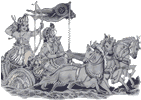
the necessity of the intervention of sattwa. The sattwic quality is a first mediator between the higher and the lower nature. It must indeed at a certain point transform or escape from itself and break up and dissolve into its source; its conditioned derivative seeking light and carefully constructed action must change into the free direct dynamics and spontaneous light of the spirit. But meanwhile a high increase of sattwic power delivers us largely from the tamasic and the rajasic disqualification; and its own disqualification, once we are not pulled too much downward by rajas and tamas, can be surmounted with a greater ease. To develop sattwa till it becomes full of spiritual light and calm and happiness is the first condition of this preparatory discipline of the nature. That, we shall find, is the whole intention of the remaining chapters of the Gita. But first it prefaces the consideration of this enlightening movement by a distinction between two kinds of being, the Deva and the Asura; for the Deva is capable of a high self-transforming sattwic action, the Asura incapable. We must see what is the object of this preface and the precise bearing of this distinction. The general nature of all human beings is the same, it is a mixture of the three gunas; it would seem then that in all there must be the capacity to develop and strengthen the sattwic element and turn it upward towards the heights of the divine transformation. That our ordinary turn is actually towards making our reason and will the servants of our rajasic or tamasic egoism, the ministers of our restless and ill-balanced kinetic desire or our self-indulgent indolence and static inertia, can only be, one would imagine, a temporary characteristic of our undeveloped spiritual being, a rawness of its imperfect evolution and must disappear when our consciousness rises in the spiritual scale. But we actually see that men, at least men above a certain level, fall very largely into two classes, those who have a dominant force of sattwic nature turned towards knowledge, self-control, beneficence, perfection and those who have a dominant force of rajasic nature turned towards egoistic greatness, satisfaction of desire, the indulgence of their own strong will and personality which they seek to impose on the world, not for the service ofman or God, but for their own pride, glory and pleasure. These are the human representatives of the Devas and Danavas or Asuras, the Gods and the Titans. This distinction is a very ancient one in Indian religious symbolism. The fundamental idea of the Rig Veda is a struggle between the Gods and their dark opponents, between the Masters of Light, sons of Infinity, and the children of Division and Night, a battle in which man takes part and which is reflected in all his inner life and action. This was also a fundamental principle of the religion of Zoroaster. The same idea is prominent in later literature. The Ramayana is in its ethical intention the parable of an enormous conflict between the Deva in human form and the incarnate Rakshasa, between the representative of a high culture and Dharma and a huge unbridled force and gigantic civilisation of the exaggerated Ego. The Mahabharata, of which the Gita is a section, takes for its subject a lifelong clash between human Devas and Asuras, the men of power, sons of the Gods, who are governed by the light of a high ethical Dharma and others who are embodied Titans, the men of power who are out for the service of their intellectual, vital and physical ego. The ancient mind, more open than ours to the truth of things behind the physical veil, saw behind the life of man great cosmic Powers or beings representative of certain turns or grades of the universal Shakti, divine, titanic, gigantic, demoniac, and men who strongly represented in themselves these types of nature were themselves considered as Devas, Asuras, Rakshasas, Pisachas. The Gita for its own purposes takes up this distinction and develops the difference between these two kinds of beings, dvau bhu¯ tasargau. It has spoken previously of the nature which is Asuric and Rakshasic and obstructs God-knowledge, salvation and perfection; it now contrasts it with the Daivic nature which is turned to these things. Arjuna, says the Teacher, is of the Deva nature. He need not grieve with the thought that by acceptance of battle and slaughter he will be yielding to the impulses of the Asura. The action on which all turns, the battle which Arjuna has to fight with the incarnate Godhead as his charioteer at the bidding of the Master of the world in the form of the Time-Spirit, is a struggle to establish the kingdom of the Dharma, the empire of Truth, Right and Justice. He himself is born in the Deva kind; he has developed in himself the sattwic being, until he has now come to a point at which he is capable of a high transformation and liberation from the traigun. ya and therefore even from the sattwic nature. The distinction between the Deva and the Asura is not comprehensive of all humanity, not rigidly applicable to all its individuals, neither is it sharp and definite in all stages of the moral or spiritual history of the race or in all phases of the individual evolution. The tamasic man who makes so large a part of the whole, falls into neither category as it is here described, though he may have both elements in him in a low degree and for the most part serves tepidly the lower qualities. The normal man is ordinarily a mixture; but one or the other tendency is more pronounced, tends to make him predominantly rajaso-tamasic or sattwo-rajasic and can be said to be preparing him for either culmination, for the divine clarity or the titanic turbulence. For here what is in question is a certain culmination in the evolution of the qualitative nature, as will be evident from the descriptions given in the text. On one side there can be a sublimation of the sattwic quality, the culmination or manifestation of the unborn Deva, on the other a sublimation of the rajasic turn of the soul in nature, the entire birth of the Asura. The one leads towards that movement of liberation on which the Gita is about to lay stress; it makes possible a high self-exceeding of the sattwa quality and a transformation into the likeness of the divine being, vimoks. ¯aya. The other leads away from that universal potentiality and precipitates towards an exaggeration of our bondage to the ego. This is the point of the distinction. The Deva nature is distinguished by an acme of the sattwic habits and qualities; self-control, sacrifice, the religious habit, cleanness and purity, candour and straightforwardness, truth, calm and self-denial, compassion to all beings, modesty, gentleness, forgivingness, patience, steadfastness, a deep sweet and serious freedom from all restlessness, levity and inconstancy are its native attributes. The Asuric qualities, wrath, greed, cunning, treachery, wilful doing of injury to others, pride and arrogance and excessive self-esteem have no place in its composition. But its gentleness and self-denial and self-control are free too from all weakness: it has energy and soul force, strong resolution, the fearlessness of the soul that lives in the right and according to the truth as well as its harmlessness, tejah. , abhayam, dhr.tih. , ahim˙ sa¯ , satyam. The whole being, the whole temperament is integrally pure; there is a seeking for knowledge and a calm and fixed abiding in knowledge. This is the wealth, the plenitude of the man born into the Deva nature. The Asuric nature has too its wealth, its plenitude of force, but it is of a very different, a powerful and evil kind. Asuric men have no true knowledge of the way of action or the way of abstention, the fulfilling or the holding in of the nature. Truth is not in them, nor clean doing, nor faithful observance. They see naturally in the world nothing but a huge play of the satisfaction of self; theirs is a world with Desire for its cause and seed and governing force and law, a world of Chance, a world devoid of just relation and linked Karma, a world without God, not true, not founded in Truth. Whatever better intellectual or higher religious dogma they may possess, this alone is the true creed of their mind and will in action; they follow always the cult of Desire and Ego. On that way of seeing life they lean in reality and by its falsehood they ruin their souls and their reason. The Asuric man becomes the centre or instrument of a fierce, Titanic, violent action, a power of destruction in the world, a fount of injury and evil. Arrogant, full of self-esteem and the drunkenness of their pride, these misguided souls delude themselves, persist in false and obstinate aims and pursue the fixed impure resolution of their longings. They imagine that desire and enjoyment are all the aim of life and in their inordinate and insatiable pursuit of it they are the prey of a devouring, a measurelessly unceasing care and thought and endeavour and anxiety till the moment of their death. Bound by a hundred bonds, devoured by wrath and lust, unweariedly occupied in amassing unjust gains which may serve their enjoyment and the satisfaction of their craving, always they think, “Today I have gained this object of desire, tomorrow I shall have that other; today I have so much wealth, more I will get tomorrow. I have killed this my enemy, the rest too I will kill. I am a lord and king of men, I am perfect, accomplished, strong, happy, fortunate, a privileged enjoyer of the world; I am wealthy, I am of high birth; who is there like unto me? I will sacrifice, I will give, I will enjoy.” Thus occupied by many egoistic ideas, deluded, doing works, but doing them wrongly, acting mightily, but for themselves, for desire, for enjoyment, not for God in themselves and God in man, they fall into the unclean hell of their own evil. They sacrifice and give, but from a self-regarding ostentation, from vanity and with a stiff and foolish pride. In the egoism of their strength and power, in the violence of their wrath and arrogance they hate, despise and belittle the God hidden in themselves and the God in man. And because they have this proud hatred and contempt of good and of God, because they are cruel and evil, the Divine casts them down continually into more and more Asuric births. Not seeking him, they find him not, and at last, losing the way to him altogether, sink down into the lowest status of soul-nature, adhama¯m˙ gatim. This graphic description, even giving its entire value to the distinction it implies, must not be pressed to carry more in it than it means. When it is said that there are two creations of beings in this material world, Deva and Asura,5 it is not meant that human souls are so created by God from the beginning each with its own inevitable career in Nature, nor is it meant that there is a rigid spiritual predestination and those rejected from the beginning by the Divine are blinded by him so that they may be thrust down to eternal perdition and the impurity of Hell. All souls are eternal portions of the Divine, the Asura as well as the Deva, all can come to salvation: even the greatest sinner can turn to the Divine. But the evolution of the soul in Nature
is an adventure of which Swabhava and the Karma governed by the swabhava are ever the chief powers; and if an excess in the manifestation of the swabhava, the self-becoming of the soul, a disorder in its play turns the law of being to the perverse side, if the rajasic qualities are given the upper hand, cultured to the diminution of sattwa, then the trend of Karma and its results necessarily culminate not in the sattwic height which is capable of the movement of liberation, but in the highest exaggeration of the perversities of the lower nature. The man, if he does not stop short and abandon his way of error, has eventually the Asura full-born in him, and once he has taken that enormous turn away from the Light and Truth, he can no more reverse the fatal speed of his course because of the very immensity of the misused divine power in him until he has plumbed the depths to which it falls, found bottom and seen where the way has led him, the power exhausted and misspent, himself down in the lowest state of the soul nature, which is Hell. Only when he understands and turns to the Light, does that other truth of the Gita come in, that even the greatest sinner, the most impure and violent evil-doer is saved the moment he turns to adore and follow after the Godhead within him. Then, simply by that turn, he gets very soon into the sattwic way which leads to perfection and freedom. The Asuric Prakriti is the rajasic at its height; it leads to the slavery of the soul in Nature, to desire, wrath and greed, the three powers of the rajasic ego, and these are the threefold doors of Hell, the Hell into which the natural being falls when it indulges the impurity and evil and error of its lower or perverted instincts. These three are again the doors of a great darkness, they fold back into tamas, the characteristic power of the original Ignorance; for the unbridled force of the rajasic nature, when exhausted, falls back into the weakness, collapse, darkness, incapacity of the worst tamasic soul-status. To escape from this downfall one must get rid of these three evil forces and turn to the light of the sattwic quality, live by the right, in the true relations, according to the Truth and the Law; then one follows one’s own higher good and arrives at the highest soul status. To follow the law of desire is not the true rule of our nature; there is a higher and juster standard of its works. But where is it embodied or how is it to be found? In the first place, the human race has always been seeking for this just and high Law and whatever it has discovered is embodied in its Shastra, its rule of science and knowledge, rule of ethics, rule of religion, rule of best social living, rule of one’s right relations with man and God and Nature. Shastra does not mean a mass of customs, some good, some bad, unintelligently followed by the customary routine mind of the tamasic man. Shastra is the knowledge and teaching laid down by intuition, experience and wisdom, the science and art and ethic of life, the best standards available to the race. The half-awakened man who leaves the observance of its rule to follow the guidance of his instincts and desires, can get pleasure but not happiness; for the inner happiness can only come by right living. He cannot move to perfection, cannot acquire the highest spiritual status. The law of instinct and desire seems to come first in the animal world, but themanhood of man grows by the pursuit of truth and religion and knowledge and a right life. The Shastra, the recognised Right that he has set up to govern his lower members by his reason and intelligent will, must therefore first be observed and made the authority for conduct and works and for what should or should not be done, till the instinctive desire nature is schooled and abated and put down by the habit of self-control and man is ready first for a freer intelligent self-guidance and then for the highest supreme law and supreme liberty of the spiritual nature. For the Shastra in its ordinary aspect is not that spiritual law, although at its loftiest point, when it becomes a science and art of spiritual living, Adhyatma-shastra,—the Gita itself describes its own teaching as the highest and most secret Shastra,—it formulates a rule of the self-transcendence of the sattwic nature and develops the discipline which leads to spiritual transmutation. Yet all Shastra is built on a number of preparatory conditions, dharmas; it is a means, not an end. The supreme end is the freedom of the spirit when abandoning all dharmas the soul turns to God for its sole law of action, acts straight from the divine will and lives in the freedom of the divine nature, not in the Law, but in the Spirit. This is the development of the teaching which is prepared by the next question of Arjuna.
Sri Aurobindo
 About Us | ©1999 - 2009 searchforlight.org
All extracts and quotations from the written works of Sri Aurobindo and the Mother and the Photographs of
the Mother and Sri Aurobindo are copyright Sri Aurobindo Ashram Trust, Pondicherry -605002 India.